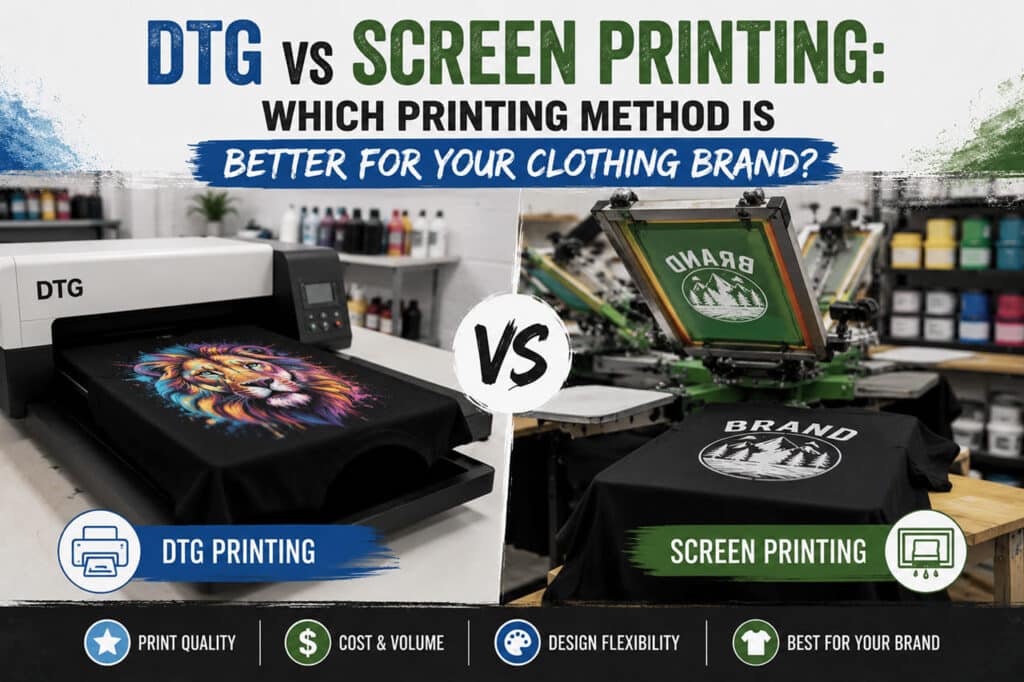
Most brand founders overthink this decision in the wrong direction. They ask which method looks better, but the real question is which method fits their production stage, fabric choice, and order volume. DTG and screen printing solve different manufacturing problems. Understanding that distinction saves money and prevents the kind of production mistakes that are expensive to walk back.
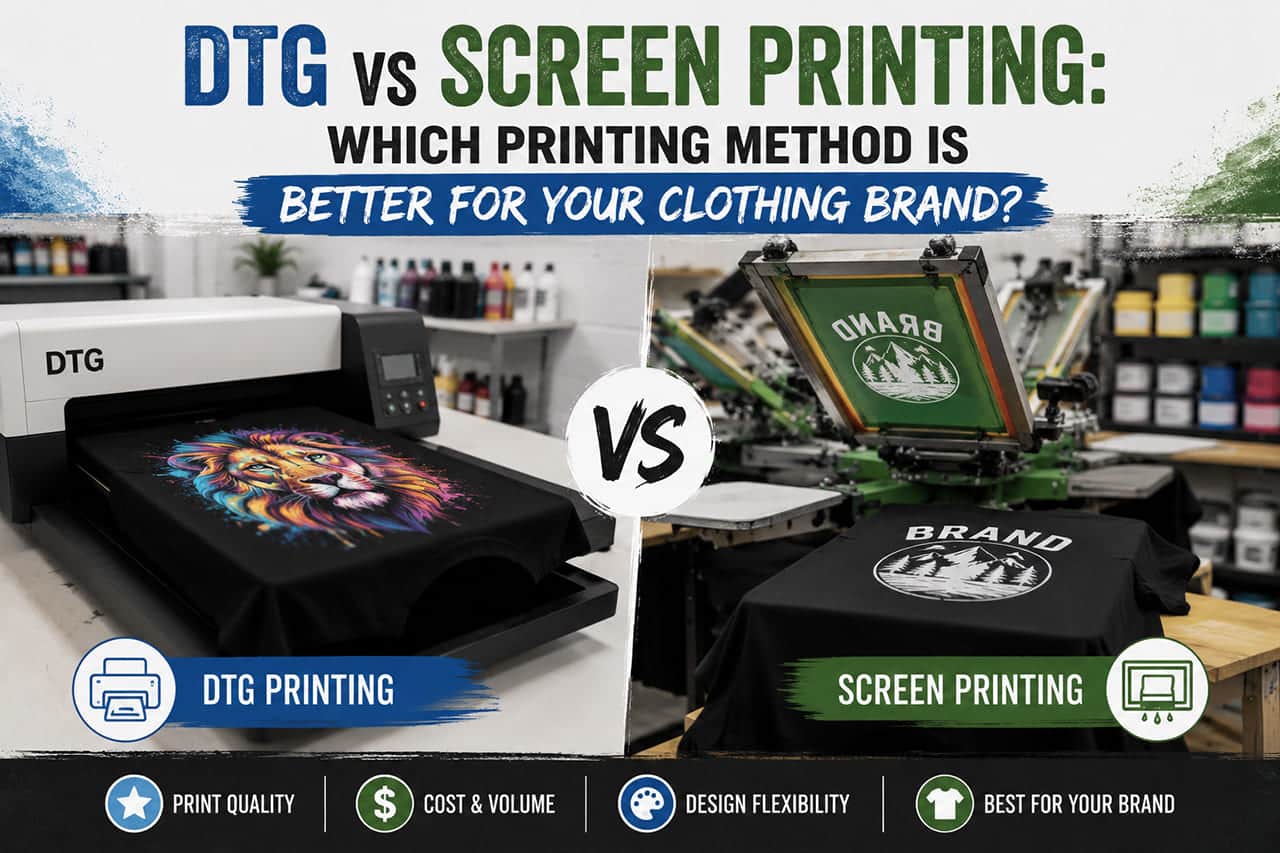
DTG applies water-based ink directly onto the fabric using a digital printer. Screen printing burns each color onto a mesh screen, then pushes ink through sequentially before curing. Both produce decorated apparel. Neither is categorically better than the other.
Key Takeaways
- DTG suits small runs, samples, and full-color designs. Minimal setup, no minimum commitment, and strong tolerance for complex artwork.
- Screen printing wins as volume grows and designs repeat. Per-unit economics shift decisively in its favor at scale, and output consistency is difficult to match.
- Fabric choice affects both methods more than most brands anticipate. DTG performs best on 100% cotton; screen printing handles a broader range of constructions.
- Streetwear brands often run both methods. DTG for testing and limited drops, screen printing for proven core pieces.
- The best method matches your business model. A startup validating demand and a wholesale brand replenishing retail accounts need different production answers.
DTG vs Screen Printing at a Glance
DTG is built for flexibility. No screen setup means a ten-color photographic design costs the same to prepare as a two-color logo. That makes it ideal for short runs, design testing, and artwork with fine detail or gradient work.
Screen printing is built for throughput. The setup is labor-intensive — each color requires its own screen — but once the press is running, production is fast, consistent, and cost-efficient in a way that DTG simply cannot replicate at volume. That is why screen printing remains the backbone of the wholesale apparel industry despite the rise of digital methods.
The mistake most brands make is choosing based on the first sample rather than thinking through what production looks like at order 3 or order 10.
What Is DTG?
Direct-to-garment printing uses an industrial printer to deposit water-based ink directly into the fabric surface. The process requires pretreatment before printing and heat curing after. Both steps directly determine print quality and wash durability.
Pretreatment bonds ink to the cotton fiber and creates the white underbase needed on dark garments. Curing thermally locks the ink into the fabric. When both are controlled correctly, DTG produces vibrant, detailed prints that hold up well. When either is rushed or inconsistent, the print fades faster than it should. That is a process problem, not a technology problem, and it is why evaluating a manufacturer's process discipline matters as much as evaluating their machine.
DTG works best for multi-color and gradient artwork, photo-realistic graphics, small batch and sample production, and custom or one-off orders.
What Is Screen Printing?
Screen printing begins in pre-press, where each color in the design is separated and burned onto an individual mesh screen. On press, ink is pushed through each screen in sequence. Flash curing between layers stabilizes wet ink. Final curing through a conveyor dryer sets everything permanently.
The front-end labor is real. Three colors means three screens, three setups, three registrations. But once the press is dialed in, throughput is high and quality is consistent across every unit. That production efficiency is what makes screen printing the right choice for repeat orders, wholesale programs, and any design that has proven demand.
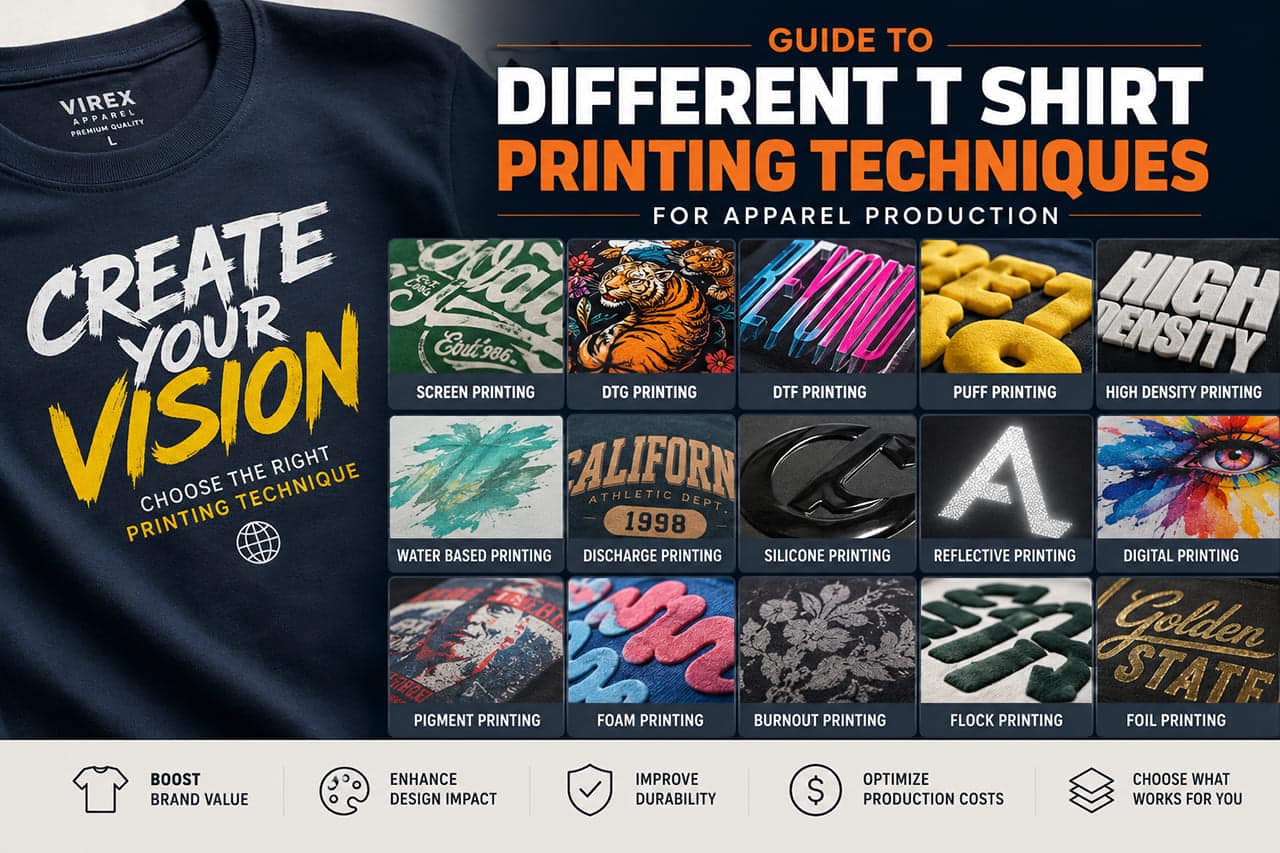
Screen printing also supports specialty ink treatments—puff, high-density, metallic, and discharge—that fall completely outside what DTG can do. For brands competing on premium presentation, those options matter.
Quick Comparison Table
| Factor | DTG | Screen Printing |
|---|---|---|
| Print Quality | Excellent for detail, gradients, full-color art | Excellent for bold, solid graphics with strong saturation |
| Cost | Better for small runs | Better for medium to large runs |
| MOQ | Low or none | Higher setup makes very small runs inefficient |
| Fabric Compatibility | Best on 100% cotton | Works across more fabric types |
| Durability | Good with proper process control | Stronger for long-term wear and repeated washing |
| Turnaround | Fast for small orders | Slower setup; faster throughput at volume |
| Best Use Cases | Samples, POD, detailed art, short runs | Bulk tees, streetwear drops, wholesale reorders |
How Each Printing Method Works
How DTG Printing Works
Artwork preparation comes first. Files need clean resolution, correct color profiles, and properly handled transparency, especially on dark garments where sizing and placement need to account for the underbase. Pretreatment is applied to the fabric, then the garment goes onto the printer platen. Ink is deposited following the digital artwork file. Heat curing finishes the process.
The margin for error is narrower than it looks. Uneven pretreatment causes patchy color. Under-curing reduces wash durability significantly. Over-curing on certain fabrics can affect hand feel. These are not rare edge cases. They are the daily variables that separate a well-run DTG operation from a poor one.
How Screen Printing Works
Film positives are output for each color and then exposed onto light-sensitive mesh screens. On press, each screen is registered to the platen, and ink is pushed through using a squeegee. Flash curing between layers prevents bleeding. After all colors are printed, the garment runs through a conveyor dryer at a controlled temperature and belt speed.
Once the press is configured and running, production speed is high. A four-color design on an automatic press can run hundreds of units per hour with consistent quality across every piece. That consistency is what wholesale buyers and retail programs depend on, and it is difficult to match with any digital method at the same price point.

Key Production Differences
Setup is the defining variable. DTG has almost none; screen printing has real front-end labor. That structure makes DTG faster and cheaper for small or varied runs, and makes screen printing more efficient and cost-effective as quantities increase and designs repeat. Understanding where that crossover happens for your specific artwork and volume is the foundation of any smart production decision.
DTG vs Screen Printing for Print Quality
DTG has the advantage on fine details. Small text, thin linework, soft shadows, and tonal gradients all reproduce reliably because the digital printer interprets the artwork directly. Adding colors to a DTG design adds zero setup cost, which makes it the natural choice for full-color illustrations, photographic prints, and any artwork where reducing color count would compromise the design.
Screen printing delivers superior color saturation and ink opacity, particularly on dark garments. The ink deposit sits differently on the surface, and the result reads with more visual weight than most DTG prints. For bold graphics on heavyweight black tees — a staple product for streetwear brands — screen printing typically produces a more saturated, premium-looking result.
On hand feel, DTG tends to be softer because the ink penetrates the fiber structure. Screen printing hand feel depends on the ink system. Plastisol prints feel heavier, especially on large coverage areas. Water-based and discharge inks produce a much softer result that can match DTG while offering significantly better durability.

DTG vs Screen Printing for Durability
Properly produced screen prints outlast most DTG prints under real-world washing conditions. Plastisol inks, when cured correctly, handle hundreds of wash cycles without meaningful degradation. Water-based screen prints require tighter process control but deliver comparable longevity.
DTG durability is achievable, but it is more dependent on variables. Pretreatment quality, curing consistency, fabric composition, and wash care all affect how long the print holds its vibrancy. Large coverage areas are the most vulnerable. Brands selling products with a premium, long-life positioning should factor that into their method decision. For garments expected to survive frequent washing over an extended period, screen printing is the more reliable clothing manufacturing choice.

DTG vs Screen Printing for Cost
The cost comparison is not just about the unit price. It is about where setup costs sit in the production equation.
DTG has minimal setup. That makes it cost-effective for small runs, samples, and orders where design variety changes frequently. Screen printing carries real setup costs per design, per color. Those costs get distributed across the total units produced, which means the more you produce, the lower the effective cost per unit.
For simple one or two-color graphics, screen printing can become the cheaper option at quantities as low as 25 to 50 units. For full-color artwork, DTG often stays competitive further up the volume range. The crossover depends on color count, print size, garment type, and the facility's labor rates. Any manufacturer worth working with should quote both options when your volume sits near that crossover.
Beyond unit price, account for the full cost picture: pretreatment materials, screen setup fees, spoilage rates, minimum order requirements, and the inventory risk that comes with ordering more units than you can confidently sell. A lower print rate does not automatically mean a cheaper production decision.
Fabric Compatibility
Fabric choice has a direct impact on print quality and durability with both methods, and it is one of the factors brands most consistently underestimate.
DTG performs most reliably on 100% cotton. Natural cotton fibers absorb water-based inks efficiently and hold pretreatment chemistry well. Heavier constructions, 180gsm and above, generally produce the best results. Cotton-poly blends become less predictable as polyester content increases. The synthetic fibers resist water-based inks, pretreatment does not bond as effectively, and dye migration during curing is a real problem on high-polyester fabrics.
Screen printing handles a broader range of constructions. With the right ink system, it works reliably on cotton, cotton-poly blends, French terry, fleece, and most hoodie constructions. For sportswear and high-synthetic-content fabrics, screen printing is the more dependable route.
Best Choice by Clothing Brand Type
Startups should start with DTG. The ability to test designs in small quantities without heavy setup costs reduces inventory risk and allows demand validation before committing to volume. Once a design proves itself with repeat orders, moving it to screen printing makes financial sense.
Streetwear brands typically get stronger results from screen printing on core pieces, particularly heavyweight tees, oversized prints, and premium hoodies. DTG remains valuable for limited drops, artist collaborations, and sample development where design complexity or short run size makes screen printing impractical.
Print-on-demand brands depend on DTG. The POD model requires fulfilling individual orders quickly without setup overhead, which is structurally incompatible with screen printing economics.
Wholesale programs should default to screen printing. Retail buyers expect consistent quality across large shipments and repeat orders. Screen printing's process-driven consistency is built for that requirement.
MOQ and Scaling Strategy
Low MOQ is one of DTG's most valuable business attributes. It separates the cost of testing from the cost of scaling. Early-stage brands can validate demand, read sell-through data, and identify which designs deserve repeat investment before committing to volume production.
The natural progression for many brands looks like this: test with DTG, identify what sells, move proven designs to screen printing for repeat production. Running both methods simultaneously is not an either-or tradeoff. It is a deliberate production strategy that many successful apparel brands use to manage both risk and efficiency at different stages of a product's lifecycle.
Switch to screen printing when a design has demonstrated repeatable demand and the same style is being reordered in meaningful quantities. That is the point where setup costs amortize effectively and the per-unit economics of screen printing start working in your favor.
DTG vs Screen Printing for Streetwear
Streetwear puts real pressure on print quality. Customers in that market read garment weight, graphic saturation, and print feel as signals of brand quality. Those details communicate something, even when buyers cannot articulate exactly what they are responding to.
Screen printing is the stronger choice for most core streetwear pieces. Oversized graphics benefit from the ink opacity and coverage consistency that screen printing delivers. The visual weight of a well-executed screen print on a heavyweight tee reads as more considered and more premium than most DTG alternatives on the same product.
Screen printing also supports specialty treatments that elevate product presentation: puff ink, high-density prints, metallic finishes, and discharge effects. These are production tools that DTG simply does not offer.
DTG still plays a role in a streetwear production model. For limited drops with complex artwork, design experiments, and sample runs where the design may change before committing to volume, DTG provides the flexibility that screen printing cannot. A well-structured custom printing approach for a streetwear brand typically uses DTG at the front end and screen printing once demand is confirmed.
How to Choose the Right Method
Choose DTG for small runs below 50 units, full-color or photographic artwork, design testing, sample production, and print-on-demand operations.
Choose screen printing for orders of 100 units or more of the same design, bold and graphic-heavy artwork, products where long-term durability is a selling point, and wholesale or retail programs requiring consistent repeat quality.
Run both if your catalog includes new designs that you are testing alongside proven core SKUs. Use DTG to validate; use screen printing to scale what earns the volume.
Decision Matrix by Order Type
| Order Type | Best Method | Why |
|---|---|---|
| 1 to 10 samples | DTG | No setup cost, fast turnaround |
| 25 to 50 short-run tees | DTG or screen printing | Depends on color count—get quotes for both |
| 100+ repeat tees | Screen printing | Better unit economics and output consistency |
| Premium streetwear drop | Screen printing | Stronger visual impact and durability |
| Custom one-off order | DTG | Flexible and efficient without minimum commitment |
| Wholesale reorders | Screen printing | Scales well, delivers consistent quality |
FAQs
Q: Is DTG or screen printing better for a new clothing brand?
A: Start with DTG. Lower upfront commitment and no high MOQ risk give you room to learn what sells before scaling. Once a design proves demand, migrate it to screen printing for repeat production.
Q: Which method is cheaper for 50 shirts?
A: It depends on the design. Simple one or two-color graphics may favor screen printing at fifty units once setup costs are spread across the run. Full-color or detailed artwork often still favors DTG at that quantity. Get quotes for both using your specific artwork and garment spec.
Q: Which method lasts longer after washing?
A: Screen printing generally has the edge, particularly for bold graphics and logo-driven designs on cotton. DTG durability is achievable but more sensitive to pretreatment quality, curing consistency, and fabric composition.
Q: Can DTG print on polyester?
A: Not reliably. Dye migration during curing is a consistent problem on synthetic fabrics. Screen printing with the appropriate low-cure ink system is the better production choice for polyester and performance fabrics.
Q: When should I switch from DTG to screen printing?
A: When the same design is being reordered in meaningful quantities and you are confident in its demand. That is the point where screen printing's setup costs amortize effectively and the economics work in your favor.
Final Recommendation
Best for Small Batches
DTG. Minimal setup, no minimum commitment, and strong tolerance for design complexity make it the right starting point.
Best for Bulk Orders
Screen printing. Once volume is meaningful and designs repeat, the unit economics and output consistency are difficult to argue with.
Best for Premium Streetwear
Screen printing. The visual weight, color saturation, specialty ink options, and durability align with what the market expects from a product at that price point.
Best for Startup Brands
DTG to validate demand. Screen printing to scale what earns repeat orders.
Best for Scaling Apparel Businesses
Screen printing for core SKUs. The economics, consistency, and durability track record make it the right infrastructure for repeatable production at scale.
Final Thought
The DTG vs screen printing question does not have a universal answer. The brands that get it right are the ones that match the method to the moment—the right design, the right fabric, the right volume, the right stage of growth. That kind of production thinking is one of the clearest markers of a brand that will still be operating three years from now.