
If you're building a clothing brand, understanding the different types of shirt printing matters more than most people realize. It affects how your product looks on day one, how it holds up after dozens of washes, and whether your production costs leave any room for profit.
Most founders don't seriously consider this until they're already knee-deep in samples. By that point, switching methods means lost time and wasted money. This guide is here to help you make the right call from the start. We'll cover the six most widely used types of shirt printing, explain how each one actually works, and give you a practical framework for picking the method that fits your brand.
What Are the Main Types of Shirt Printing?
The custom shirt printing industry looks very different today than it did ten years ago. Digital technology has opened up options that simply didn't exist before. You can now print a single shirt with photographic-quality detail and no setup fee, or permanently embed color into fabric at the fiber level. That's genuinely exciting. It also makes the decision more complicated.
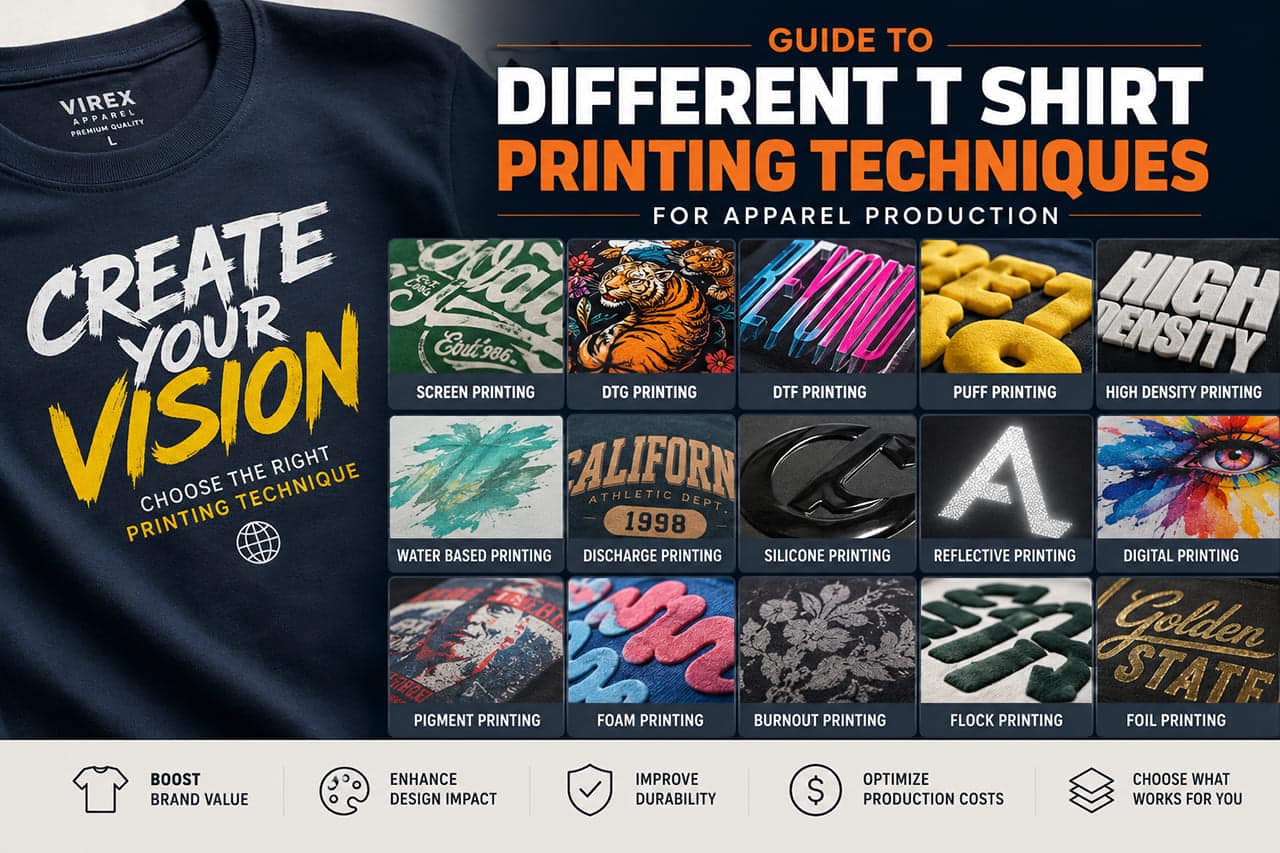
The 6 types of t shirt printing methods that matter most for brand owners today are:
- Direct-to-Garment (DTG) Printing
- Screen Printing
- Sublimation Printing
- Heat Transfer Printing
- Puff Printing
- Discharge Printing
Each one works differently, produces a different result, and suits a different type of brand. Here's what you need to know about all of them.
1. Direct-to-Garment (DTG) Printing

How It Works
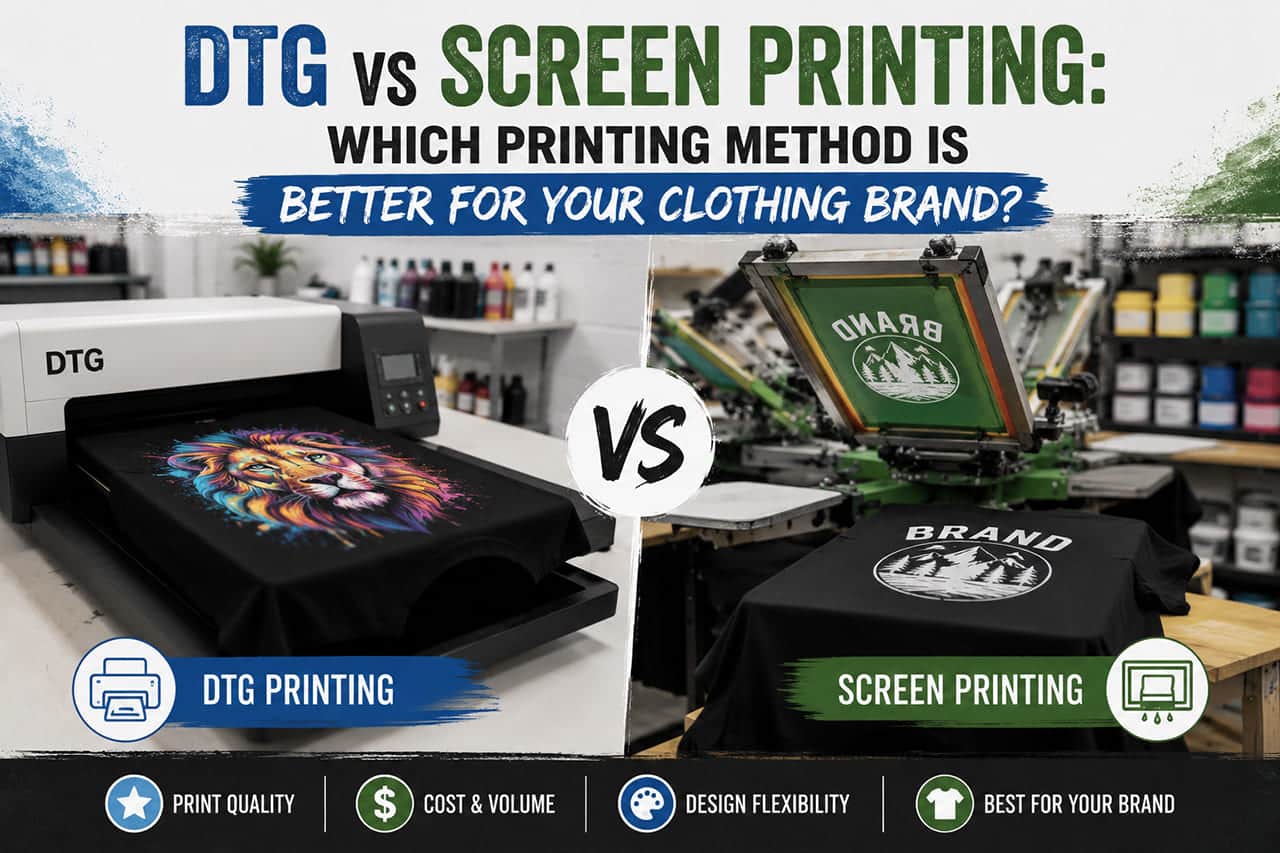
Think of DTG printing as an inkjet printer for fabric. The shirt is laid flat on a platen and fed through a specialized machine that sprays water-based inks directly onto the surface of the garment. On dark fabrics, a pretreatment solution is applied first to help the ink bind properly and prevent color bleed. Once printing is complete, the garment goes through a heat press or conveyor dryer to cure the ink.
Because everything runs from a digital file, there are no screens to set up and no color separations to manage. You can print one shirt just as easily as fifty. The whole process takes minutes. When comparing modern types of shirt printing, DTG stands out for its flexibility and ability to handle complex artwork.
Pros
- No setup fees and no minimum order requirement, which makes it genuinely accessible for early-stage brands
- Reproduces complex artwork with impressive accuracy, including gradients, photography, and fine line detail
- Produces a soft hand feel when the ink is properly cured, as it absorbs into the fabric rather than sitting on top
- Fast turnaround for small batches and on-demand orders
Cons
- Cost per unit stays high regardless of how many pieces you order, which limits its appeal once you're producing at scale
- Performs best on 100% cotton; results on polyester blends tend to be less vivid and less consistent
- Less durable than screen printing over the long term, especially with frequent washing
Best For
Print-on-demand businesses, artists releasing limited drops, and new brands that want to test several designs before locking in on a large production run.
2. Screen Printing

How It Works
Among the different types of shirt printing, screen printing is the method the apparel industry was built on, and it's still the dominant choice for high-volume production. A separate mesh screen is created for each color in the design, with a stencil blocking off the areas that won't receive ink. The printer pushes ink through the open areas of each screen using a squeegee, applying one color at a time. After all colors are laid down, the garment is heat-cured to bond the ink permanently to the fabric.
Setup is time-consuming and manual. But once the screens are ready, production moves at speed. A commercial press can turn out hundreds of identical garments per hour.
Pros
- Delivers rich, vibrant color with strong opacity, making it one of the best-looking finishes available
- Extremely durable; a well-made screen print can outlast the garment itself
- Cost per unit drops sharply at volume, making it the most economical option for large orders
- Works across a wide range of fabric types and supports specialty inks
Cons
- High upfront setup cost, since each color in the design requires its own screen
- Not practical for small orders; the setup cost makes low-quantity runs uneconomical
- Doesn't handle photographic detail or gradients well, as the process requires clearly defined color areas
Best For
Brands producing runs of 50 or more units with bold, graphic-driven designs and a consistent color palette. It's the standard choice for streetwear labels, corporate merchandise, and team uniforms.
3. Sublimation Printing

How It Works
Sublimation printing works differently from the other types of shirt printing techniques on this list. Rather than placing ink on top of the fabric, the process uses heat and pressure to convert specially formulated dye into a gas. That gas bonds directly with the polyester fibers at a molecular level. The print doesn't sit on the surface. It becomes part of the fabric itself.
The process starts with printing the design onto transfer paper using sublimation inks. The paper is laid over the garment and pressed at high heat, which triggers the conversion and bonding. When the press opens and the paper is peeled away, the design is locked in permanently.
Pros
- Produces stunning all-over, edge-to-edge prints with photographic quality and unlimited color range
- The ink bonds permanently with the fibers, so there is no cracking, peeling, or fading with normal washing
- Has zero impact on hand feel; the finished garment feels exactly like unprinted fabric
Cons
- Only works on polyester or high-polyester-blend fabrics; it won't produce usable results on cotton
- Limited to white or very light base garments; sublimation on dark fabric produces washed-out, low-contrast results
- Not a viable path for brands committed to natural fiber products
Best For
Activewear brands, sportswear labels, and any brand building around full-coverage designs on performance fabrics.
4. Heat Transfer Printing

How It Works
Heat transfer printing is an umbrella term for a group of techniques that share the same basic logic. A design is produced on a separate material, either transfer paper or vinyl, and then bonded to the garment using a heat press. Vinyl designs are cut from colored sheets and applied as a single layer. Paper transfers are printed digitally, then pressed onto the garment where the design releases from the paper and adheres to the fabric.
It's one of the most accessible methods out there. Equipment costs are relatively low, setup is minimal, and you can turn around a small order quickly. That's why it's a popular choice for event merchandise and one-off custom pieces.
Pros
- Works across a wide range of garment types, fabric colors, and styles with very little preparation
- Minimal setup time makes it practical for very small orders where other methods aren't cost-effective
- Vinyl transfers in particular can achieve a clean, sharp finish on simple designs
Cons
- The least durable method on this list; heat-transferred prints are prone to cracking and peeling over time, especially with standard transfer paper
- The finished print often has a stiff or plasticky feel against the skin, which can lower the perceived quality of the garment
- Doesn't compete with screen printing on cost once order volumes start to climb
Best For
Event merchandise, promotional giveaways, one-off personalized pieces, and brands that need flexibility across a wide variety of garment styles and colors.
5. Puff Printing

How It Works
Puff printing is a specialty version of screen printing that introduces a three-dimensional quality to the finished design. A puff additive is mixed into the ink before it's applied through the screen. When the garment passes through the heat tunnel during curing, the additive causes the ink to expand and rise off the fabric, creating a raised, tactile texture.
The setup process is the same as standard screen printing, with separate screens per color and minimum quantity requirements. The difference is entirely in what the finished product looks and feels like.
Pros
- Creates a distinctive raised texture that stands out clearly in person and photographs well for product listings
- Adds a premium, streetwear-forward feel to logos and typography that flat printing simply can't replicate
- Works well for brand identities built around bold, graphic-forward aesthetics
Cons
- Fine detail is lost as the ink expands; puff printing only works well with simple shapes, clean text, and bold logos
- Adds cost on top of standard screen printing rates
- Not available from every manufacturer, which can restrict your production options
Best For
Streetwear labels and lifestyle brands that want to give their core logo or wordmark a tactile, premium quality as a deliberate design detail.
6. Discharge Printing

How It Works
Discharge printing is less commonly talked about, but it produces one of the most coveted finishes in premium apparel. Instead of placing ink on top of the fabric, the process uses a chemical agent to remove or neutralize the existing dye in the garment. This leaves a lightened or undyed area in the exact shape of the design. A replacement color is often added at the same time. The result is a print that sits completely flush with the fabric surface, with no raised texture and no physical layer you can feel.
Because the discharge agent works by reacting chemically with the fabric dye, the process requires 100% cotton garments dyed with reactive dyes. Not every blank on the market is compatible.
Pros
- Produces an exceptionally soft hand feel; it's arguably the softest finish you can achieve in shirt printing
- Creates a vintage, worn-in aesthetic that resonates strongly with premium lifestyle consumers
- Achieves a soft, matte quality on dark garments that layered ink printing cannot replicate
Cons
- Requires reactive-dyed 100% cotton blanks, which limits your sourcing options
- Color consistency can vary subtly between dye lots, making precise color matching harder to guarantee across batches
- More technically complex than standard printing and not offered by all manufacturers
Best For
Premium lifestyle brands, vintage-inspired labels, and any brand where the feel and subtlety of the finished product matter as much as how it looks.
Comparing the 6 Types of Shirt Printing
When you compare different types of shirt printing, key differences become clear. DTG has no setup cost but stays expensive per unit regardless of how large the order gets. That makes it the smart choice for small runs but a poor fit for bulk production. Screen printing works in the opposite direction. The setup is costly, but the per-unit price drops substantially at volume, and the durability is the best of any method here.
Sublimation is highly cost-effective at scale for polyester products, and the print quality is outstanding. The hard limit is fabric compatibility. Heat transfer is the easiest and cheapest method to get started with, but it's the least durable of the group. Puff and discharge sit at the premium end of the spectrum. Both add cost, and both require higher minimum quantities. What they offer in return is a finished product that looks and feels meaningfully different from anything produced by a standard method.
How to Choose the Right Printing Method for Your Brand
With 6 types of shirt printing on the table, the decision becomes much clearer when you work through three straightforward questions.
What fabric are you printing on?
This is the most important variable and often the most constraining one. If your product is built on 100% cotton, every method on this list is technically available to you. If you're working with polyester performance fabrics, sublimation becomes the obvious choice. If a premium soft finish on natural fiber is central to your brand, discharge printing is worth taking seriously.
What's your order volume?
If you're launching with a test run of 20 or 30 units, screen printing's setup costs will destroy your margins. DTG or heat transfer makes far more sense at that stage. Once you're ordering 100 or more units of the same design on a consistent basis, screen printing's economics start working in your favor in a big way. Brands operating on a print-on-demand model belong in DTG territory regardless of volume.
What does your design actually require?
Photographic artwork, gradients, and complex multi-color illustrations are best handled by DTG or sublimation. Bold two- or three-color logos thrive in screen printing. If texture and tactile detail are part of your brand language, puff printing adds something no flat method can. And if the feel of the finished garment matters as much as how it looks, which is true for many premium labels, discharge printing is worth the added complexity.
Understanding the full range of types of shirt printing available to you, and what each one costs at your target volume, is the foundation for making a confident production decision. Manufacturers like Virex Apparel, which works across multiple production scales and printing methods, can be a useful sounding board when you're trying to match a technique to your brand's positioning, timeline, and budget.
Common Mistakes to Avoid
Judging everything by the sample.
A sample can look great under almost any method. The real question is whether the quality holds up after 30 washes, and whether it can be reproduced consistently across a 200-unit run.
Ignoring the cost curve.
DTG is affordable for five shirts. It gets expensive for five hundred. Screen printing works the other way around. Many founders make their choice based on their current order size without thinking about what happens when they grow.
Going premium before validating demand.
Discharge and puff printing are higher-cost techniques that support higher retail prices. But investing in them before you know your audience will pay that price is an unnecessary risk. Test with a simpler method first. Upgrade when the volume justifies it.
Assuming every manufacturer offers every method.
Discharge and puff printing are not universal. If either of these is central to your product, confirm availability and minimum requirements with your manufacturer before it becomes a core part of your brand strategy.
Conclusion: Matching the Right Method to Your Business
There is no universally correct answer when it comes to the types of shirt printing available today. There is only the right answer for your specific situation.
For startups testing the market with complex artwork and limited budgets, DTG gives you the freedom to move quickly and experiment without committing to large runs. For brands scaling up with clean, graphic-driven designs, screen printing offers a quality-to-cost ratio that nothing else can match. For performance and activewear labels, sublimation is the only method that works at the fiber level and delivers true edge-to-edge coverage. And for brands where premium feel and a distinctive finish define the product, discharge or puff printing can create something that standard methods simply cannot.
The brands that get this right treat their printing method as a deliberate strategic choice. Start with your fabric, understand your volume trajectory, match the method to your margin structure, and build from there. The right choice, made early and applied consistently, becomes part of what makes your product worth buying.