Oversized t-shirts look simple. That is part of their appeal. But from a manufacturing standpoint, they are among the most technically demanding garments in contemporary casualwear, and brands that underestimate this tend to find out the hard way.
The core misunderstanding is treating oversized as a size rather than a silhouette. What you actually need is a purpose-built approach, one that starts with the right pattern block, the right fabric, and a clear development process from the very beginning.
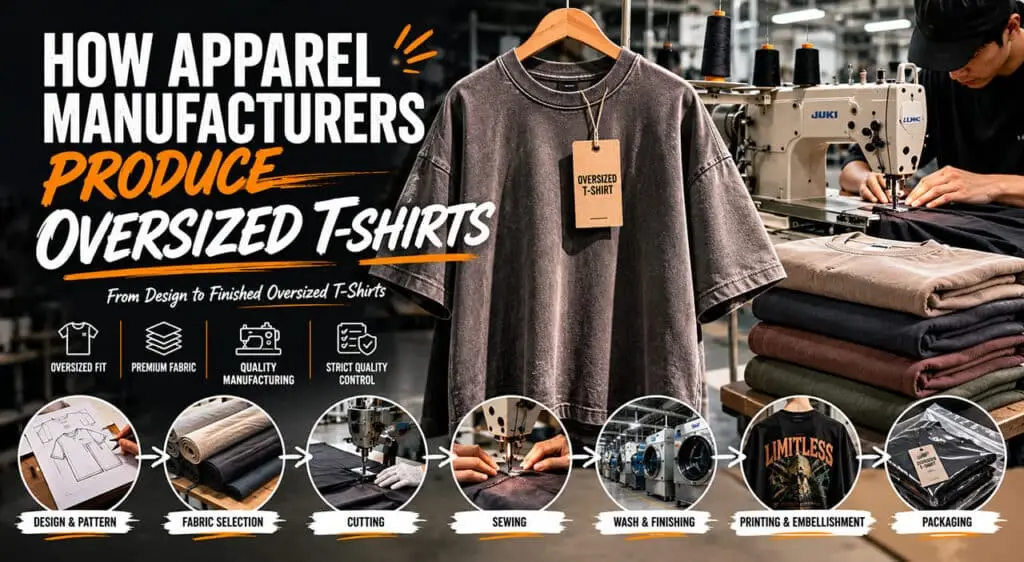
This article walks through how experienced manufacturers approach oversized t-shirts at each stage, from pattern engineering and fabric selection through to washing, quality control, and bulk production.
Key Takeaways
- Oversized t-shirts require dedicated pattern block designed specifically for them, as grading up standard fit template results in silhouette that appears ill-fitting rather than intentional.
- Fabric weight is structural decision in oversized t-shirt manufacturing, with heavyweight oversized t-shirts developed at 280 GSM and above to maintain shoulder geometry, boxy silhouette, and dimensional stability across wash cycles.
- The complete tech pack with oversized-specific size charts and finished garment measurements is the foundation of consistent sampling and successful bulk production.
- Garment washing is a core development stage, not a finishing step, as enzyme wash programs directly alter hand feel, pre-shrink dimensions, and define the final texture of the finished product.
- Brands that partner with an experienced apparel manufacturer from the earliest development stage produce oversized t-shirts that perform to specification in bulk, avoiding the fit inconsistencies and production variables that result from treating oversized as a simple scaling exercise.
Understanding Oversized T-Shirt Fit Development
Oversized fit is a silhouette, not a size. Taking a medium block, grading it up to a 2XL, and calling it oversized is one of the most common and costly mistakes in garment development. The result is always the same: fabric pooling in the wrong areas, an unintentional drape, and a fit that reads as ill-fitting rather than considered.
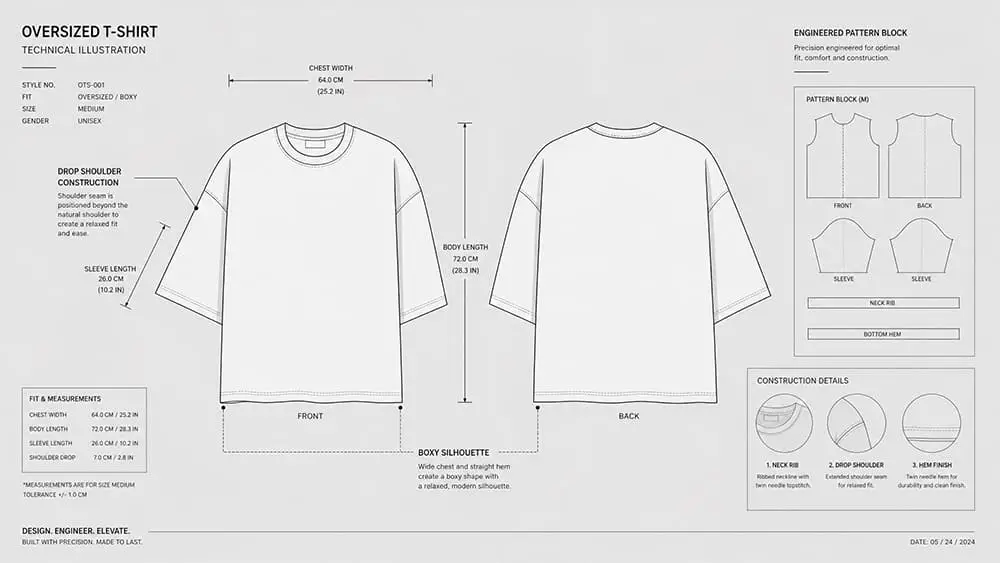
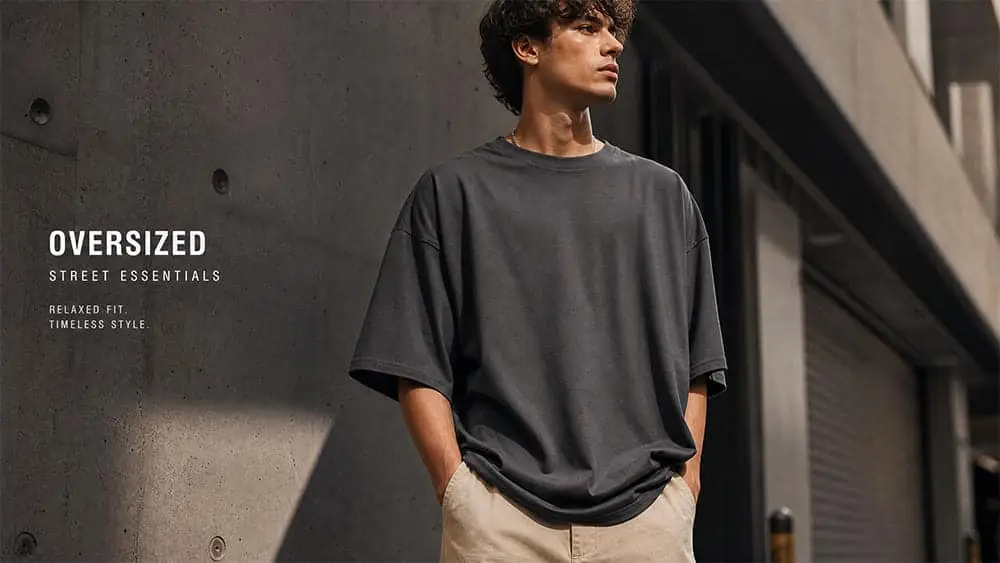
Proper oversized construction starts with the drop shoulder. In conventional t-shirts, the sleeve head sits at the natural shoulder point. In an oversized cut, the shoulder seam is deliberately shifted down the arm, repositioning the sleeve attachment and creating a wider, more relaxed upper body. That one change reconfigures the geometry of the entire garment, and the sleeve, chest width, and body length all need to be re-engineered around it.
The boxy pattern holds consistent width from chest to hem, forming a clean rectangle from the front. Getting this right without the garment looking shapeless takes careful attention to hem width, side seam angle, and how the ribs finish at the cuff and neckline. These details are what separate a garment that looks deliberate from one that simply looks large.
Shoulder width, body length, and sleeve length all affect each other, and the relationship between them determines whether the silhouette reads as intentional or just oversized by accident. This is why oversized t-shirts need their own dedicated pattern block built from scratch, not adapted from a standard fit template.
Choosing Fabrics for Oversized T-Shirts
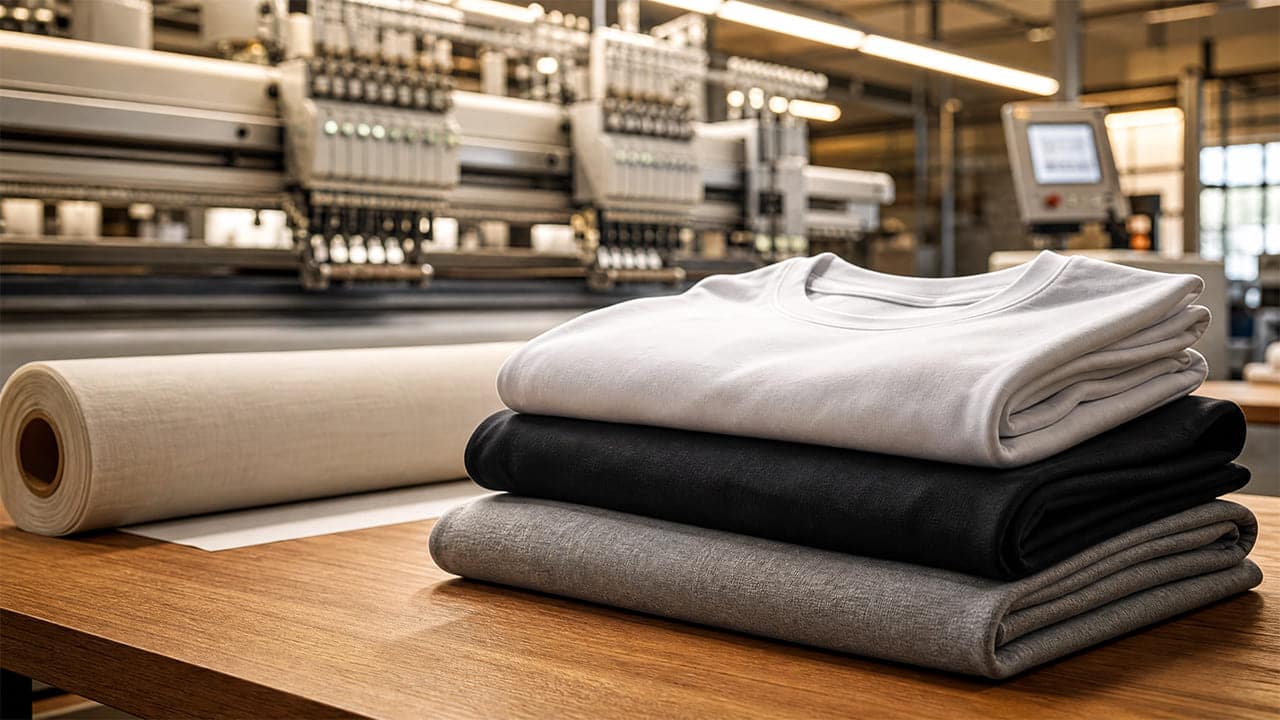
In the fitted style, fabric weight is mostly a comfort consideration. In an oversized cut, it becomes structural. The wrong weight and the silhouette collapse regardless of how well the pattern is constructed.
At 180 GSM, fabrics work for lightweight seasonal styles, but there is not enough body weight to hold a true oversized silhouette. Without sufficient mass, the fabric clings and collapses in ways that undermine the cut entirely.
240 GSM is the mid-weight standard that balances drape and structure effectively. It carries enough weight to fall cleanly away from the body while remaining comfortable across a wide range of conditions, making it a reliable starting point for premium casualwear.
For heavyweight oversized t-shirts, the specification is usually required to be 280 GSM and above, especially when brands are looking for the best fabric for oversized t-shirts with a more premium and structured look. The tighter knit doesn't distort with stretching, maintains the shape of shoulders and hems after multiple washes, and provides the heft the premium market demands. The big difference is that, in this context, structure and weight need to work together. The heavier yarn in an open knit will not give the same effect as a proper dense construction.
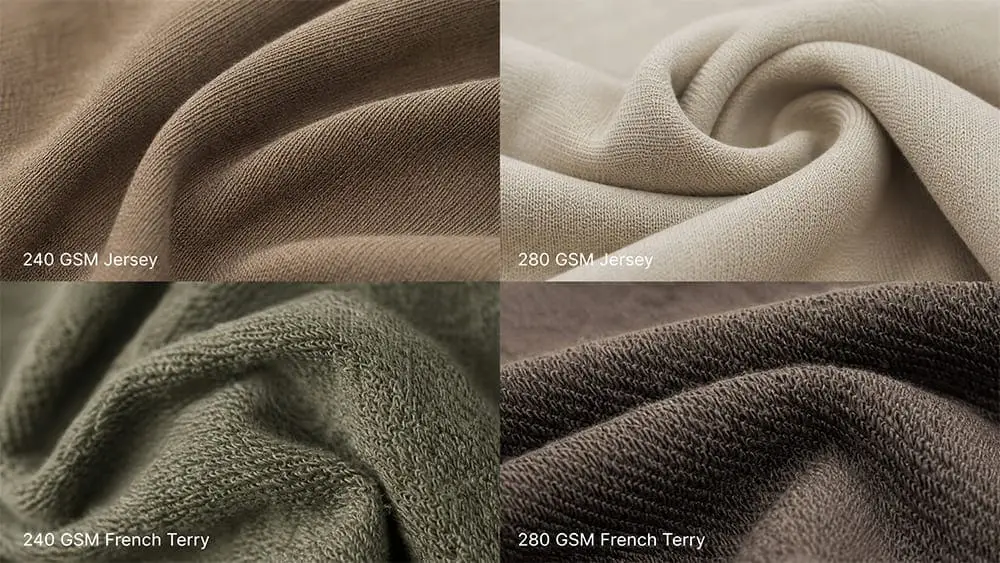
Yarn count plays the meaningful role in the final product's character. Finer 40S yarns give a smoother surface, a cleaner print base, and a softer touch. Coarser 21S yarns produce a more textured, substantial fabric with vintage-influenced hand feel that suits garment-washed finishes particularly well.
On fiber, 100% cotton remains the standard for premium oversized styles. It breathes well, dyes cleanly, and responds predictably to washing. Cotton and polyester blends offer better dimensional stability and reduced shrinkage, which makes them more practical for mid-market production where wash consistency is the priority.
Tech Pack, Sampling, and Product Development
Building Complete Tech Pack
The tech pack is where it all starts in the development process. When learning how to create tech pack documents professionally, brands need to understand that a good tech pack is one that covers finished garment measurements, construction specifications, stitch types, trim details, label placement, and fabric callouts. It is the one true source of truth from the first sample through bulk production, and any lack of clarity can lead to a misalignment between design intent and what the factory actually builds.
Writing Size Charts for Oversized Fits
Size charts for oversized styles must specify measurements such as chest width, shoulder width, body length, and sleeve length as finished garment dimensions, not body measurements. The manufacturer working with proper oversized block builds the size chart around the intended silhouette. Standard size grading increments do not apply.
Proto Samples: Validating the Pattern
Proto samples are where the tech pack becomes a physical garment for the first time. The goal is straightforward: validate the pattern logic. Does the drop shoulder sit where it should? Does the body width read correctly when worn? Significant correction at this stage is normal and expected. The proto exists specifically to catch these issues before they become expensive.
Fit Samples and Oversized Fit Adjustments
Fit samples are where the detail work happens. Shoulder balance, sleeve proportions, and garment drape are all evaluated closely. Oversized t-shirts almost always require multiple fit rounds because adjusting one measurement creates proportional consequences elsewhere. Extending sleeve length changes how the drop shoulder reads, which can then require a correction to chest width or body length.
Pre-Production Approval and the Development Workflow
Pre-production approval locks all measurements, construction details, and fabric specifications before bulk cutting begins. Nothing changes after this point without a formal revision. It is the checkpoint that protects both the manufacturer and the client, and it marks the transition from development into production.
Production, Washing, and Quality Control
Bulk Sewing and Construction Precision
Oversized garments are unforgiving in bulk sewing. Because the panels are large and the cut is wide, any deviation in stitch tension or seam alignment is amplified in the finished garment in ways that would be invisible in a fitted style. Consistent machine tension and active supervision throughout the run are non-negotiable.
Neck Rib Construction
Neck rib attachment requires precisely calibrated tension. Too little and the neckline flares outward. Too much and it puckers, distorting the chest drape. Getting it right requires experienced operators, consistent machine settings, and active monitoring throughout the run rather than a single check at the start.
Garment Washing as Core Development Stage
Garment washing is not a finishing touch. It fundamentally changes the garment, and those changes need to be accounted for from the pattern stage onward. Wash shrinkage is built into the pre-wash cut measurements so the finished garment hits the approved dimensions after washing.
Enzyme Wash Programs
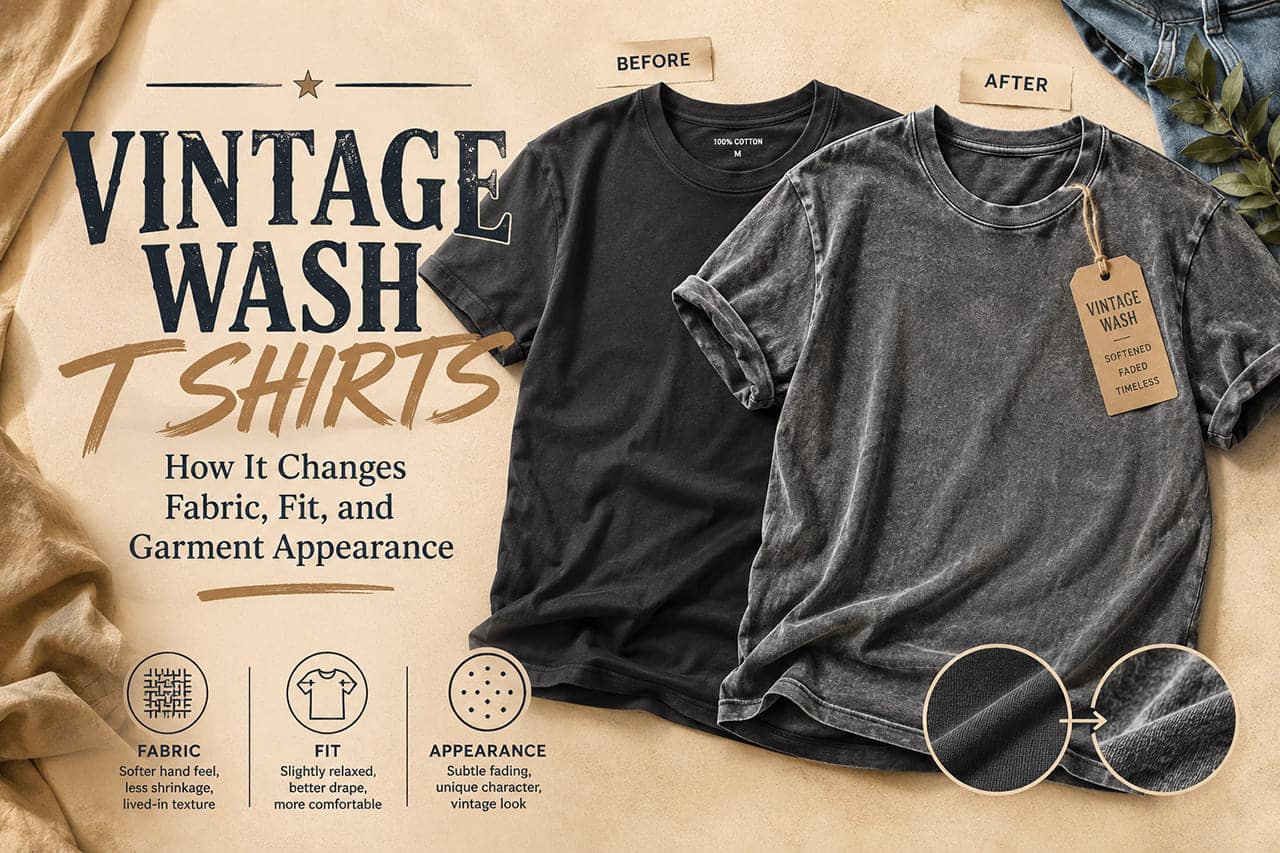
Enzyme washing breaks down surface fibers to produce a softer hand feel, a slightly faded tone, and a relaxed texture that fresh fabric cannot replicate. For oversized styles, it also pre-shrinks the garment under controlled conditions, stabilizing dimensions before the product reaches the customer. The wash program needs to be developed with the same rigor as the pattern and fabric specification.
Shrinkage Testing Across Wash Cycles
Shrinkage testing across multiple wash cycles establishes accurate shrinkage rates that get built into the pre-wash cut measurements. Oversized silhouettes are particularly vulnerable to shrinkage imbalance, where body length and chest width shrink at different rates and alter the proportional relationship that fit development established.
Common Oversized T-Shirt Production Issues
A few production problems come up consistently in oversized manufacturing and need active management:
- Neck stretching caused by handling during the washing process
- Side seam twisting from fabric tension imbalance in the knit construction
- Shrinkage imbalance between body and sleeve panels, which distorts the approved silhouette
Experienced manufacturers know to watch for these. The key is catching them through structured inline inspection rather than discovering them in finished goods.
Quality Control Inspection
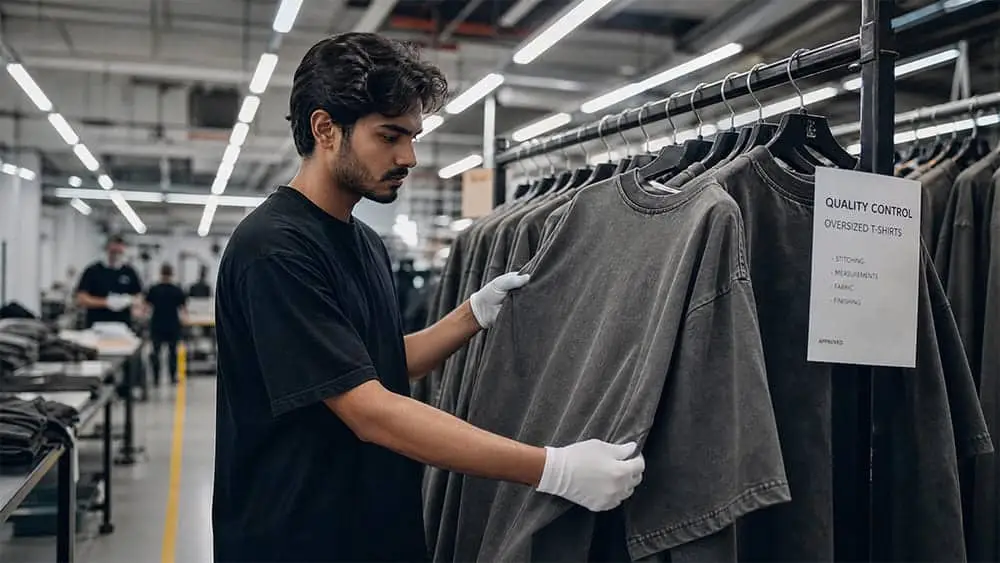
The proper QC process for oversized t-shirts runs across three stages. Inline inspection during sewing catches construction errors before they multiply. Post-wash measurement checks confirm finished dimensions against the approved spec. A final audit before packing verifies the product meets the standard the client approved. Each stage has specific function, and skipping any of them creates risk that tends to surface at the worst possible moment.
MOQ, Pricing, and Brand Positioning
Heavyweight oversized t-shirts cost more to produce, and not simply because they use more fabric. Heavier fabric is harder to cut accurately, requires adjusted machine settings throughout sewing, and places greater demands on washing equipment. These costs are built into the production process and cannot be removed without changing the product.
MOQ requirements vary by factory tier and complexity. Entry-level programs typically start at 300 to 500 units per colorway. Facilities that can wash garments and source premium fabrics usually require minimum order of 500 to 1,000 units. This is because they have fixed costs for fabric procurement, sample development, and production setup.
Premium streetwear labels invest in proprietary fabric development, extended sampling, and controlled distribution, accepting higher unit costs because the product differentiation justifies it. Fast fashion operations work with lighter fabrics and standardized fits to compress price and speed to market.
Sustainable materials, including organic cotton and recycled fiber blends, carry a real cost premium. Brands need to decide early whether that cost gets absorbed into margin or passed through to retail pricing. It needs to be a deliberate decision built into the product architecture from the start.
Conclusion
There is no shortcut in oversized t-shirt manufacturing. The drop shoulder pattern, the fabric weight, the wash program, the quality control process—each stage connects to the next, and a weak link anywhere shows up in the finished product.
Brands that engage with capable manufacturer from the start build products that hold up across bulk production and deliver what the customer expects. The quality of the finished garment reflects exactly the quality of the development process behind it.
FAQs
Q: What is the difference between oversized t-shirts and standard t shirts that have been graded to larger size?
A: Oversized t shirts are built on a dedicated pattern block with drop-shoulder construction, adjusted sleeve proportions, and a boxy body width calibrated to create an intentional silhouette. Grading a standard pattern larger produces excess fabric in the wrong areas and a fit that reads as unintentional, which is a common and costly development mistake.
Q: What GSM should I specify for heavyweight oversized t shirts?
A: For heavyweight oversized t shirts, 280 GSM and above is the standard specification. At this weight, the fabric structure is dense enough to hold the boxy silhouette, resist stretch distortion at the shoulder and hem, and deliver the substantial hand feel that premium casualwear customers expect.
Q: How many samples should I expect before my oversized t shirt is approved for bulk production?
A: Most oversized t-shirt manufacturing programs require two to three sampling rounds before pre-production approval. Because drop shoulder placement, sleeve length, and body width are interdependent, a correction to one measurement typically requires proportional adjustments across the pattern, which is why single-sample approvals are rarely achievable in oversized development.
Q: What are typical MOQ requirements for a quality oversized t-shirt manufacturing program?
A: MOQ requirements vary by factory tier and product specification. Most capable facilities that offer garment washing and premium fabric sourcing set minimums between 500 and 1,000 units per colorway. Programs with lower complexity may begin at 300 units, though this typically limits access to specialized finishing and fabric options.
Q: Does garment washing affect the final measurements of oversized t shirts in bulk production?
A: Yes, and an experienced apparel manufacturer accounts for this at the pattern stage. Wash shrinkage is built into the pre-wash cut measurements so that the finished garment hits the approved dimensions after washing. Shrinkage testing across multiple wash cycles is conducted during development to establish accurate shrinkage rates before bulk production begins.