Choosing the best GSM for hoodies is not just a style decision; it is a product development choice that affects drape, warmth, durability, silhouette, and customer satisfaction. From a manufacturing perspective, the right hoodie fabric weight depends on how the garment will be worn, how it will be constructed, and what kind of brand experience you want to create.
What GSM Means for Hoodies
GSM stands for grams per square meter, which is the standard way to measure fabric weight. In simple terms, it tells you how much a square meter of fabric weighs, so a higher GSM usually means a denser and heavier hoodie fabric. Industry sources such as the Textile Institute define GSM as the primary metric for fabric weight in apparel production.
Why fabric weight matters
Fabric weight affects how a hoodie feels in the hand, how it hangs on the body, and how much structure it holds after washing. A lighter hoodie may feel softer and more breathable, while a heavier one can create a more premium, substantial feel that works well for streetwear hoodies and oversized hoodies.
Why GSM alone is not enough
GSM is important, but it does not tell the full story. Two hoodies with the same GSM can feel completely unique depending on whether they are brushed fleece hoodies, French terry hoodies, cotton fleece hoodies, or cotton-poly blends. Yarn quality, knit density, finishing, and garment construction all change the final result.
Best GSM by Use Case
The best GSM for hoodies depends on the intended use, season, and brand position. A good manufacturer does not choose GSM in isolation; they choose it based on the wear scenario and the target customer.
Best GSM for everyday wear
For everyday wear, a range around 280 to 350 GSM is often a practical balance. It provides enough body to feel substantial without becoming too hot or bulky for regular use.
Best GSM for winter hoodies
For winter hoodies, 400 GSM hoodie fabric and above is usually the better choice. Heavier fabric improves insulation and creates a warmer feel, especially when paired with brushed fleece or a double-layer construction.
Best GSM for streetwear hoodies
For streetwear hoodies, many brands prefer 400 to 500 GSM because that range delivers structure, visual weight, and a premium silhouette. This is where heavyweight hoodies start to feel intentionally engineered rather than just thick.
Best GSM for oversized hoodies
Oversized hoodies usually benefit from heavier fabric because the extra body helps the garment hold shape. If the GSM is too low, the fit can look sloppy instead of boxy; if it is too high, the hoodie may become stiff and overly rigid.
Best GSM for premium blanks
Premium hoodie blanks often sit in the 380 to 500 GSM range, depending on the desired market. The goal is not simply to use the heaviest fabric available, but to create a balanced blank that feels dense, consistent, and easy for brands to decorate.
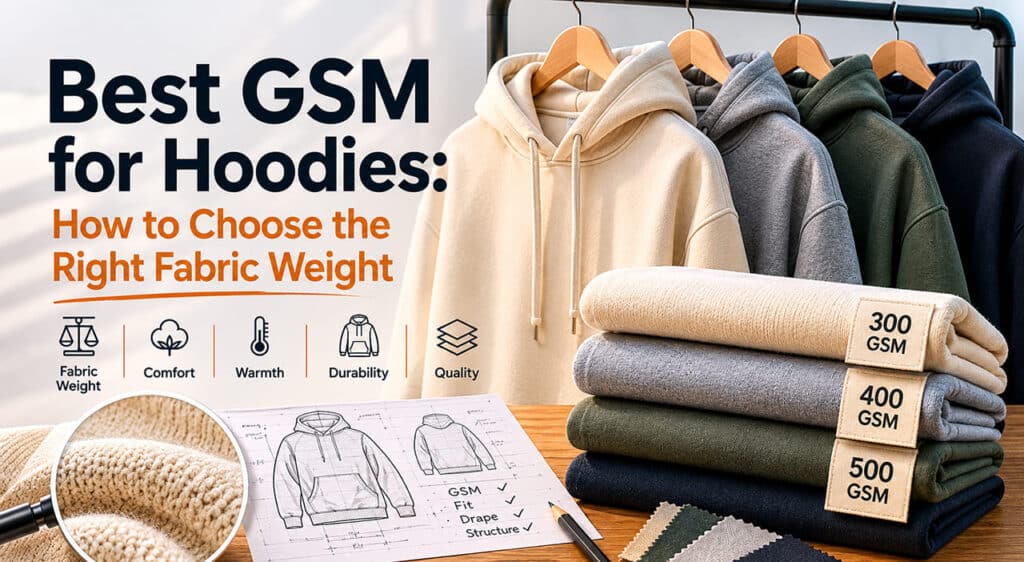
300 vs 400 vs 500 GSM
These three weight ranges are the most common comparison point for buyers. They each serve a different product strategy, and the right choice depends on fit, climate, and brand positioning.

300 GSM hoodie feel and use
A 300 GSM hoodie usually feels lighter, more flexible, and easier to wear year-round. It works well for casual collections, transitional seasons, and customers who want comfort without too much bulk.
400 GSM hoodie feel and use
A 400 GSM hoodie is where many brands begin to position a product as heavyweight. It usually has enough substance to improve drape and structure while still remaining wearable for daily use.
500 GSM hoodie feel and use
A 500 GSM hoodie feels noticeably dense, substantial, and more luxurious in hand. It can be excellent for premium streetwear hoodies, but it can also feel too warm or stiff if the fabric system is not balanced properly.
When to choose each weight
Choose 300 GSM when comfort, breathability, and broad wearability matter most. Choose 400 GSM when you want a true premium feel with strong structure. Choose 500 GSM when the goal is maximum visual weight, cold-weather performance, or a luxury heavyweight statement.
What Changes Hoodie Quality Beyond GSM
A hoodie's final quality depends on much more than fabric weight. If brands ignore the fabric system behind the number, they often end up with products that look good on a spec sheet but underperform in real use.
If you are evaluating heavyweight hoodies for a premium collection, it is important to look beyond GSM and understand the full construction and finishing standards behind the garment. This guide explains what makes premium heavyweight hoodies truly high quality, from fabric weight and knit density to fit, structure, and finishing. For a broader comparison of fiber types and performance, this guide on best fabric for hoodies is a useful supporting reference.
For a technical overview of how fabric weight, knit structure, and finishing interact in knitwear production, the American Association of Textile Chemistry and Colorists (AATCC) offers authoritative resources on textile testing and quality control.
Cotton vs cotton-poly
Cotton fleece hoodies usually have a more natural handfeel and can feel softer over time. Cotton-poly blends often improve durability, recovery, and dimensional stability, which can be helpful in bulk production.
Brushed fleece vs French terry
Brushed fleece hoodies usually feel warmer and softer inside, while French terry hoodies are typically lighter and more breathable. If you want a deeper explanation of fabric construction, this guide on what French terry fabric is explains the base structure clearly. For buyers comparing these two options for hoodie production, French terry vs fleece is the most relevant supporting article.
Yarn count and knit density
Yarn count and knit density affect how compact and refined the fabric feels. A lower-quality yarn can make even a high-GSM hoodie feel rough, while a tighter knit can improve structure and reduce the cheap, floppy look brands want to avoid.

Finishing, compacting, and shrinkage
Finishing processes such as brushing, enzyme washing, and compacting can change the final handfeel and stability of the hoodie. Shrinkage is especially important, because a fabric that is not properly stabilized can change shape after wash and alter the intended fit.
Single-layer vs double-layer construction
Single-layer hoodies feel lighter and easier to move in, while double-layer hoodies provide more body and warmth. The construction choice can change the experience as much as the GSM itself, especially in the hood, front panel, and pocket area.
Hoodie Manufacturing Considerations
Manufacturing realities matter because a hoodie must not only look good on a hanger but also sew cleanly, wash well, and produce consistently at scale. Heavier fabrics create different production challenges than lighter ones.
Seam bulk and stitch behavior
At higher GSM, seam bulk increases, especially in the hood, pocket openings, side seams, and rib attachments. Stitch settings must be adjusted carefully so the hoodie stays clean, flat, and durable rather than looking overbuilt.
Hood shape and rib recovery
The hood needs enough fabric structure to sit correctly, while ribbing needs strong recovery to maintain shape over time. If the fabric is too soft or unstable, the hoodie can lose its premium silhouette after repeated wear and washing.
Sample-to-bulk consistency
One of the biggest mistakes brands make is approving a great sample and assuming bulk production will match perfectly. GSM tolerance, finishing variation, and supplier inconsistency can all change the final hoodie, which is why sample-to-bulk control is critical.
Wash testing and quality control
Wash testing should always be part of hoodie development, especially for heavyweight hoodie fabric. Brands need to check shrinkage, twisting, pilling, colorfastness, and shape retention before approving bulk production.
For standardized testing methods related to fabric shrinkage, colorfastness, and durability, manufacturers often follow AATCC test methods that define how garment quality is measured in the industry.
How to brief a factory
A strong factory brief should include target GSM, fiber composition, knit type, finish, shrinkage allowance, fit target, and decoration method. If you only request a weight number, the factory has too much room to interpret the product differently from your intention.
Streetwear and Heavyweight Hoodie Insights
Streetwear brands are often buying for silhouette, attitude, and perceived value as much as comfort. That is why heavyweight hoodies have become such a common choice in premium and oversized collections.
Why heavyweight hoodies feel premium
Heavyweight hoodies feel premium because they hold shape, create visual structure, and communicate substance immediately. The garment looks more intentional, especially when the fabric density supports a clean boxy or oversized fit.
How GSM affects oversized fit
Oversized hoodies need enough body to drape properly without collapsing. A fabric that is too light will hang like a regular hoodie in a bigger size, but a properly weighted fabric helps create the strong streetwear shape brands want.
Why some heavyweight hoodies feel stiff
A heavy hoodie can still feel bad if the yarn, knit, or finishing is wrong. Excessive stiffness often comes from poor balance between density and softness, not from GSM alone.
Common heavyweight hoodie sourcing mistakes
Brands often assume that heavier automatically means better. Common mistakes include choosing GSM before fit, ignoring shrinkage, overestimating warmth, and buying a fabric that looks premium in photos but wears poorly on body.

How to Choose the Right GSM for Your Brand
The right GSM should support your product strategy, not fight it. A good hoodie spec should align with the customer you are targeting, the season you are selling into, and the price point you need to hit.
When choosing hoodie fabric weight for a brand collection, GSM should be evaluated together with drape, recovery, and product positioning. Brands building premium streetwear hoodies often combine this decision with a broader quality review, such as the standards covered in premium heavyweight hoodies and best fabric for hoodies.
Match GSM to customer expectation
If your customer wants comfort and easy wear, a midweight hoodie may outperform a heavier one. If your audience expects luxury streetwear hoodies, a higher GSM will usually feel more aligned with the brand.
Match GSM to climate and season
Climate matters because a hoodie that performs well in winter may be too heavy for warmer regions or year-round use. Brands selling globally should think carefully about whether one fabric weight can serve all markets.
Match GSM to price point and margin
Heavier fabric usually increases cost, shipping weight, and sometimes production complexity. That can be worth it for a premium hoodie, but it needs to be priced correctly or it will hurt margins.
Match GSM to print or embroidery method
Decoration method also matters. Screen printing, embroidery, and specialty finishes all behave differently on thick fabric, so the chosen GSM should support the decoration without distorting the garment.
FAQ
Q: What GSM is best for hoodies?
A: There is no single best GSM for all hoodies. For many brands, 300 to 400 GSM is a practical range, while premium streetwear and heavyweight hoodies often sit closer to 400 to 500 GSM.
Q: Is 400 GSM heavyweight?
A: Yes, 400 GSM is commonly considered heavyweight in hoodie fabric weight discussions. It is a strong middle ground for brands that want structure and premium feel without going to extreme bulk.
Q: Is 500 GSM too heavy?
A: Not necessarily, but it depends on the intended use. A 500 GSM hoodie can be excellent for luxury streetwear or winter collections, but it may be too warm or rigid for everyday casual wear.
Q: Does higher GSM mean better quality?
A: No. Higher GSM only means heavier fabric, not better fabric. Quality depends on yarn, knit density, finishing, shrink control, and construction.
Q: What is the best fabric for streetwear hoodies?
A: For streetwear hoodies, many brands prefer cotton fleece hoodies or brushed fleece hoodies in a heavyweight range. French terry can also work when the brand wants a more breathable, lighter streetwear look.
Final thoughts
The best GSM for hoodies is the one that matches your end use, your brand positioning, and your production capabilities. If you want a hoodie that feels premium, holds its shape, and performs well in bulk, do not choose GSM by number alone—choose it as part of a complete fabric and manufacturing strategy. For brands and consumers alike, the winning hoodie is not just heavy; it is engineered to wear well, wash well, and look right on the body.